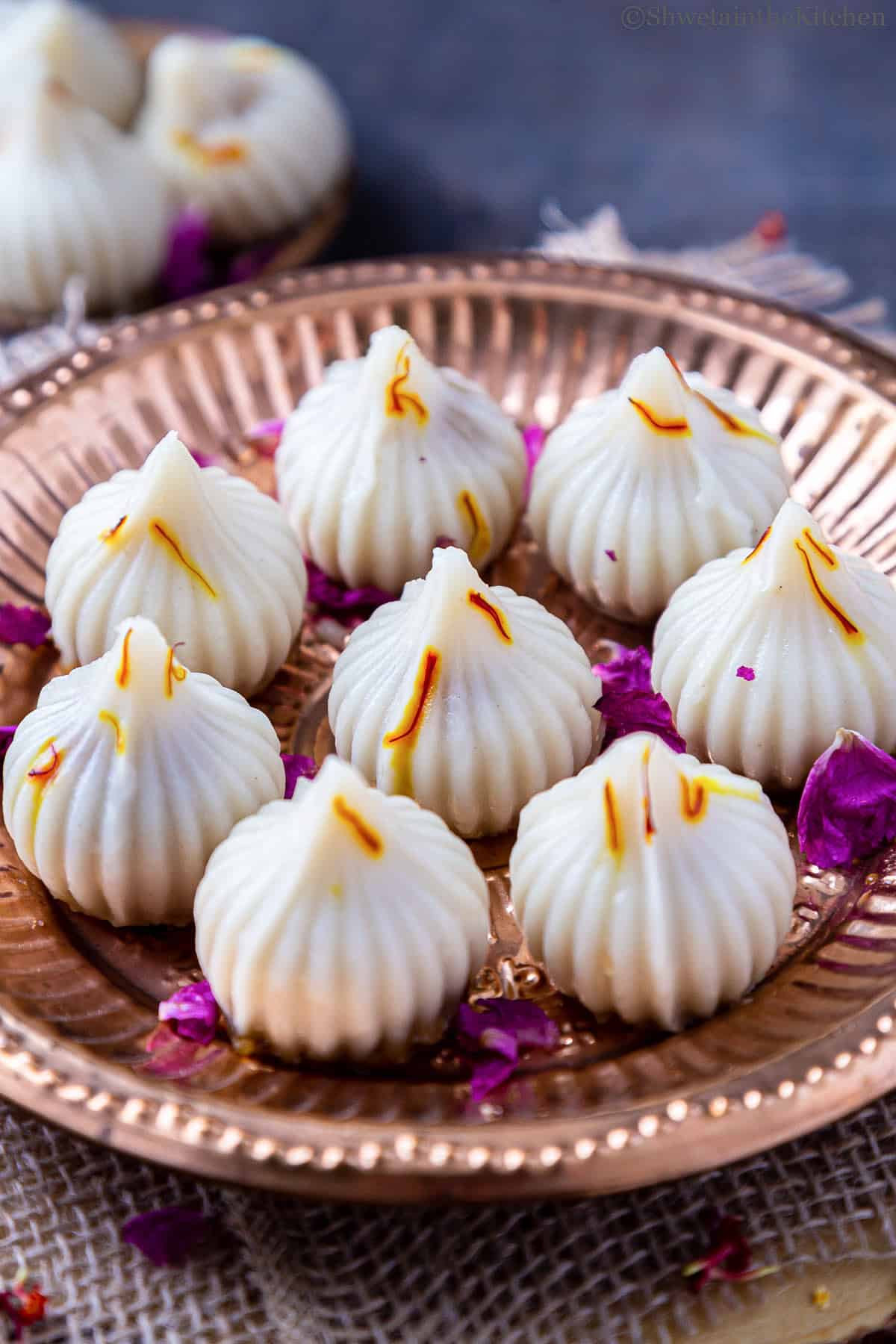
Indian Festival Special Sweets - "Ukadiche Modak"


image credit

Hello readers,

     Today is 'Ganesh Chaturthi' so I am wishing all my readers 'Happy Ganesh Chaturthi'. For this reason I'm going to share with you a traditional Indian delicacy which is most famous for being the favorite dessert of Hindu deity Ganesha and it is always prepared as a religious offering during the 'Ganesh Chaturthi' festival. 'Modak' is an Indian sweet dumpling believed to have originated in the state of Maharashtra, in India. Modak is prepared in a variety of ways, however the most common variety is called "Ukadiche Modak". So let's start making famous dessert for Lord Ganesha!🙏


Ingredients:

For Modak fillings:-

1. Grated coconut- 200g.

2. Grated Jaggery- 150g.

3. Dry fruits- 1/2 cup(crushed).

4. Cardamom powder- 1/2 tsp.

5. Poppy seeds- 1/2 tsp.

6. Nutmeg powder- 1/8 tsp.

7. Ghee (clarified butter)- 1 tsp.

For Modak cover:-

1. Fine Rice flour- 150g.

2. Ghee (clarified butter)- 1 tsp.

3. Water- 1-1/2 cups (more to knead).

4. Salt- 1/4 tsp.

For Garnishing:-

1. Ghee (clarified butter)- 1 tsp.

2. Saffron- few strings (optional).

Preparation Method:

Inner Modak sweeter fillings-

Step 1- Place a pan over medium heat add 1 tsp ghee (clarified butter), now add poppy seeds once seeds start crackling add jaggery  and grated coconut mixed well until mixture turns thick. There shouldn't be excess moisture in the pan (don't over cook).

Step 2-  Once get sticky texture add crushed dry fruits, cardamom powder and nutmeg powder mix well, turn off flame and cool this mixture completely.

Making outer of Modak:-

Step 1- Take a pan add 1-1/2 cups water bring it to a rolling boil along with salt and ghee (clarified butter).

Step 2- Lower flame then add fine rice flour and mix well by stirring frequently, do not look for a dry and crumbly dough at this stage. Turn off flame and cover the pan, set aside. Let the dough steam in the residual heat.

Step 3- When the mixture is still slightly hot, knead it to a soft non-sticky yet smooth crack free dough, sprinkle 2-3 tbs more warm water at this stage.

Step 4- Divide dough in equal size, make balls with them. Keep the balls covered with a damp cloth until finish making all Modak.

Step 5- Grease Modak mould lightly with ghee, take a ball keep the ball inside the mould and press with finger to spread the dough towards the sides of the mould.

Step 6- Stuff the sweet coconut fillings and seal the Modak carefully.

Step 7- Grease the steam basket, open the moulds and place all the Modak in the basket, sprinkle some saffron.

Step 8- Place a trivet in a steamer pour 2 cups water & bring it to a rolling boil, now place the steam basket inside and steam cook Modaks for 10 minutes.

Step 9- Pour ghee before serving to 'Lord Ganesha'. 🙏
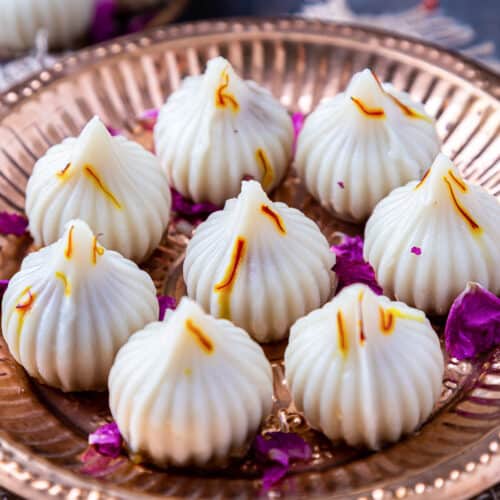
  image credit

Comments

Last week's top

Nadru/ Kamal Kakdi' or ki ke Kofte(Kofte made with Lotus stem)

Dear friends,          Today I am here to share with you a healthy yet tasty recipe, 'lotus stem kofte.' In India, the lotus stem is also known as Kamal kakdi and Nadru. Lotus stem is usually round and white to light green. It includes empty air cubicles that run the length of the stem. The vegetable has a light, slightly sweet flavor and is suitable for eating raw or cooked. You can use this vegetable in salads, pickled or cooked into curries, and stir-fried with pork or seafood. Before sharing the recipe, let me share with you the benefits of lotus stem:-  Lotus stem is a rich source of calcium, iron, and fiber- The calcium in the lotus stem forms bone strength and density as well as heart function. The iron in this vegetable is useful for boosting hemoglobin and myoglobin production in our blood. The fiber in the lotus stem is significant for helping you to control digestive and bowel health. Lotus stem increases, our consumption of antioxidants:- Edible...

Thai Green Curry Recipe

  image credit Hello readers, Today I'm going to share with you "Thai green curry" recipe. Green curry evolved during the reign of king Rama VI or Rama VII between the years 1908-1926. Ingredients: 1. Boneless chicken-500g (cut into 1.5 cm cubes) breast and thigh portion of chicken. 2. Thai green curry paste-4 tbsp. 3. Coconut milk-1.5 cups. 4. Thai sweet basil leaves- 8 pieces. 5. Chicken stock- 1/2 cup. 6. Eggplants- 70g (1.5cm cubes). 7. Oyster mushrooms- 70g( small pieces). 8. Bamboo shoots- 1/2 cup. 9. Kaffir lime leaves- 4 pieces.(broken halves). 10. Palm sugar- 2 tbsp. 11. Fish sauce- 2 tbsp. 12. Coconut cream- 1 cup. 13. Vegetable oil- 2 tbsp. 14. Red spur chilies -2 ( julienned). Preparation Method: Step 1- In a blender add sweet basil leaves (4) with half portion of coconut milk and make mixture with it set aside in a bowl. Step 2- Place a wok on the gas oven add vegetable oil and remaining coconut milk and bring it to boil till it became thick. Step 3- Add gree...

Muri Ghanto- Fish head Pulao

  Dear Friends,     Today I am here to share a heavenly tasty fish delicacy, 'Murighanta.' This dish is usually made with the fish head, but sometimes many used fishtail too. I always use fish head because, in fishtail, there are thin bones that bother me while eating.      It is believed that this dish appears from Spanish paella. Many believed that the dish originated during the ports of Kalingapatnam. The authentic Muri Ghanto, maximum eaten in Bengal and Assam, till date. This dish is made by smashing the head, which is cooked with local rice variety. And it is a common breakfast dish in the central parts of Odisha and Bengal. So, let's start making 'Muri ghanta.' Ingredients:- Katla Fish Head- 1 medium size(can use rohu fish head). *Gobindo bhog* Rice (follow my previous https://hive.blog/hive-148441/@sunitahive/ilish-polau-a-traditional-bengali-fish-recipe ilish pulao post to know about this rice)- 1cup. Potatoes- 2 medium(diced). Onion- 1me...