
Meetha Bhaat (Zarda Pulao)


Hello Friends,

      Today I am going to share with you a cuisin which you will love to eat once you made " Meetha Bhaat" also known as "Zarda Pulao" is a sweet dish,said to be Persian origin. The 'Zarda' word comes from the Persian word ' Zard' which means 'Yellow', referring to the color it obtains.

      The Zarda is popularized in North India( Himachal Pradesh) by Mughals. The "Ain-I -Akbari" of " Abul Fazal" explains the recipe of 'Zard Birinj'. Hope you like the story behind the famous cuisin.

Ingredients:-

1. Basmati Rice/Gobindo bhog rice- 1 cup.

2. Ghee(clarified butter)- 4tbsp.

3. Sugar- 1/4cup.

4. Orange food color-1/2 tsp.

5. Milk-3/4cup.

6. Almonds- 15 pieces.

7. Cashew nuts-15 pieces.

8. Golden Raisins- 1/4 cup.

9. Dry coconut- 4tsp.

10. Cinnamon stick-1(1-inch).

11. Cloves-4 pieces.

12. Green cardamom-4 pods.

13. Fennel seeds- 1 tbsp.

14. Saffron-1/4tsp.

Preparation Method:-

Step 1- Rinse the rice and soak for 10 minutes.

Step 2- Soak saffron strands, orange food color to Luke warm milk,set aside.

Step 3- Boil 3 cups of water with cloves (2pieces), cinnamon stick(1/2 inch), green Cardamom pods(2 pieces). Now add soaked rice cook until 80% done,drain and set aside.

Step 4- Heat ghee in a vessel, now add fennel seeds stir fry the seeds on low flame until fragrant. Now add remaining cinnamon stick,cloves,green cardamom pods and fry for few seconds.

Step 5- Now add almonds, cashew nuts,dry coconut,golden raisins and fry for a minute on low flame.(taking care not to burn them).

Step 6- Next add sugar and allow to little caramelized, shouldn't change its color to brown. Add 1/4 cup of water and let sugar syrup to boil.

Step 7- Now add cooked rice into it and add saffron & food color milk, slowly mix them, else rice will be broken.

Step 8- Cover the vessel and cook for 10 minutes on low flame or until all the moisture evaporates. Turn off flame.

Step 9- Now it's ready to serve.
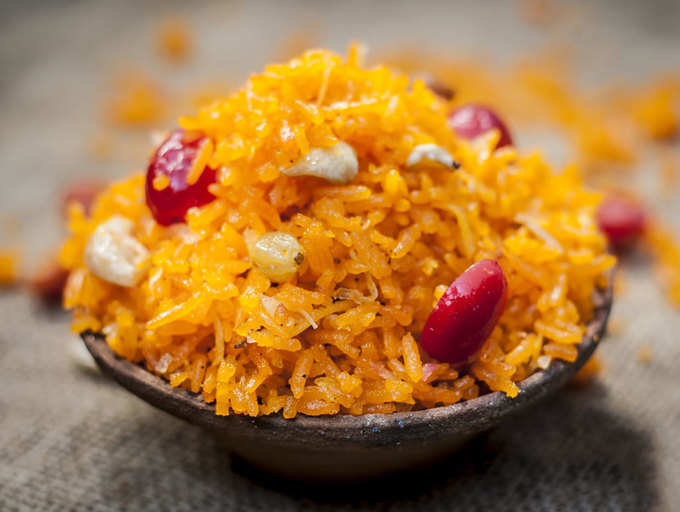

image credit: source1, source2

Comments

Last week's top

Nadru/ Kamal Kakdi' or ki ke Kofte(Kofte made with Lotus stem)

Dear friends,          Today I am here to share with you a healthy yet tasty recipe, 'lotus stem kofte.' In India, the lotus stem is also known as Kamal kakdi and Nadru. Lotus stem is usually round and white to light green. It includes empty air cubicles that run the length of the stem. The vegetable has a light, slightly sweet flavor and is suitable for eating raw or cooked. You can use this vegetable in salads, pickled or cooked into curries, and stir-fried with pork or seafood. Before sharing the recipe, let me share with you the benefits of lotus stem:-  Lotus stem is a rich source of calcium, iron, and fiber- The calcium in the lotus stem forms bone strength and density as well as heart function. The iron in this vegetable is useful for boosting hemoglobin and myoglobin production in our blood. The fiber in the lotus stem is significant for helping you to control digestive and bowel health. Lotus stem increases, our consumption of antioxidants:- Edible...

A traditional Bangladeshi "fish recipe" - Malai Koi (Creamy climbing perch)

         image source Hello readers, Today, let's go out of India. Bangladesh is our neighbouring country, they also like to eat fish like us. I'm going to share a recipe called "Malai/Dudh Koi (মালাই/দুধ কই)" also known as "Jessore Koi", one famous recipe of Jessore from Bangladesh. Are you familiar with the name of this fish "Koi" ? It's called "climbing perch" in English, and the scientific name is  Anabas testudineus.  Here is a picture of Koi fish-     image source : profishingvideos Ingredients: 1) Koi Fish (5-6 pc) big size. 2) Coconut Milk (Malai) 2-3 cups 3) Mustard oil - 100 ml 4) Green chilies - 3 to 4     Coconut Milk image source   Please red " How to prepare Coconut Milk " Spices: 1) Onion-2 medium size 2) Garlic- 3 clove's for fry/1 tea spoon paste. 3) Cumin-2 tea spoon powder/1 tea spoon whole. 4) Bay leaves - 2 pc 5) Salt-To taste 6) Sugar-To taste 7) T...

Mughlai Kebab Recipe - "Tunde ke Kebab"

   Hello readers,       Today I'm going to share a Nawabi delicacy of Lucknow in India "Tunde ke Kebab". The history of kebab is quite interesting. It was created keeping the special needs and desires of an ageing Nawab called "Wajid Ali Shah" of Lucknow. The nawab had lost his all teeth but his passion for meat remained same. So melt in mouth kebab was prepared in his royal kitchens to satisfy the Nawab's love for meat. The original recipe is supposed to be a top kept secret with the use of 160 spices and flavorings.     "Nawab Wajid Ali Shah", organized a kebab making contest and announced that the creator of the softest and succulent Kebabs would enjoy royal patronage on winning. The secret recipe was created by 'Haji Murad Ali', who apparently had only one hand. "Tunde"( a hand disability). Amongst all who took part in the contest "Tunde ke Kebab" tuned to be and undisputed winner. That's how the kebab is named a...